

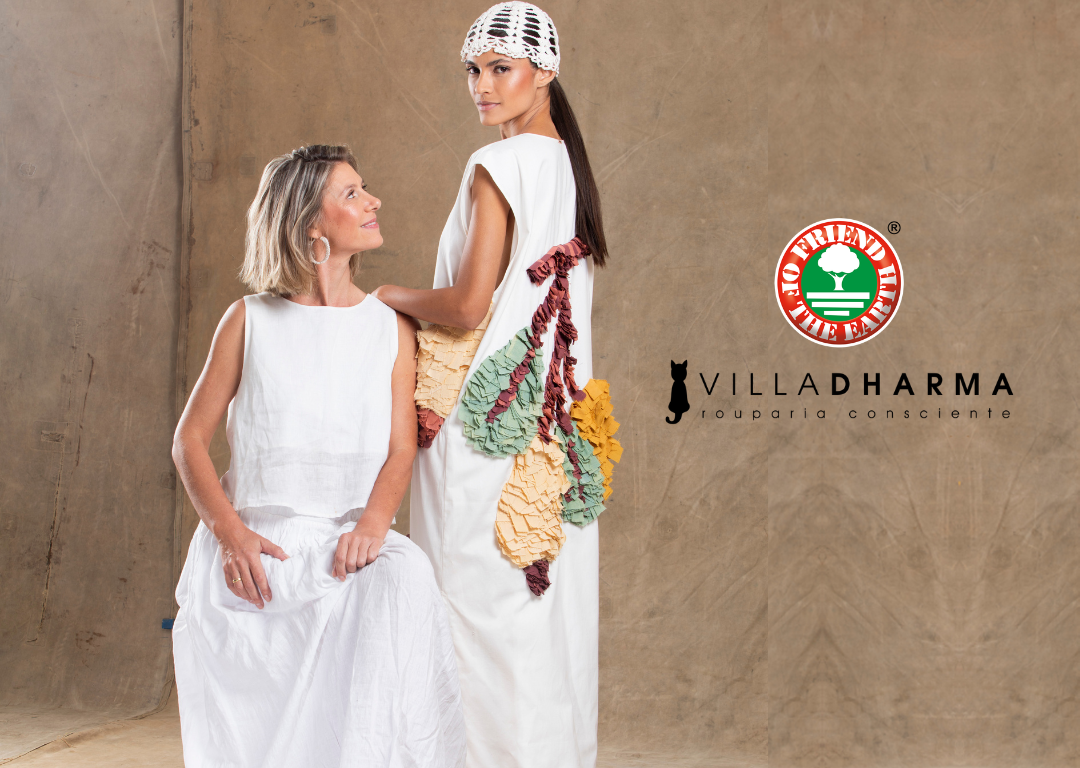
Certified by Friend of the Earth, the Brazilian fashion brand champions women artisans and local traditions. Its experience will be featured in a free webinar on 29 October, exploring social responsibility and certification in fashion.
A production network made up of 98% women, support for 15 local families, and artisanal techniques passed down through generations. These are some of the defining features of Villa Dharma, a Brazilian designer fashion brand founded in 2023 by Vanessa Stadtlober in Pium, Rio Grande do Norte, and certified by Friend of the Earth, a programme of the World Sustainability Organization.
The brand’s name comes from the Sanskrit word dharma, understood by Villa Dharma as purpose, which the brand lives as a shared commitment.
Based at Ecovila Pau Brasil, a two-hectare agroforest in Pium, Rio Grande do Norte, Villa Dharma uses natural fibres, and all its garments are dyed using natural dyes. Brazilwood (pau-brasil) dye comes from sawdust obtained through sustainable pruning, without felling trees; turmeric comes from a local agroforest; and crajiru, which produces pink tones, grows in front of the atelier. Its organic cotton knit collections, Renovar and Pachamama, use plant- and mineral-based pigments from its partner Etnobotânica in Itamonte, Minas Gerais.
The latest collection of the brand, Patuá (Spring/Summer 2027), draws inspiration from the Brazilian amulet of the same name, a symbol of protection and hope. It was presented in Milan in September 2026, following Encantarias do Nordeste Brasileiro, shown there in September 2025.
Projects supporting local communities
Villa Dharma’s social commitment includes supporting initiatives that preserve artisanal skills and create economic opportunities. VILLAGE and Village Roots are initiatives created by the brand to promote local fashion, artisans and artists through direct hiring, collaborations and partnerships.
Its collaborators include women artisans in Reduto, who preserve Labirinto, a form of drawn-thread embroidery; the lacemakers of Alcaçuz, who make bobbin lace; and Richelieu embroiderers in Rio Grande do Norte, including Joelma, Kekel and Simone. The brand also acknowledges the work of designer Felipe Bezerra and artists Ariell Guerra, Flor Atirupa and Henrique Araujo across its collections.
Villa Dharma also contributes to social inclusion initiatives such as Casulo do Bem, which engages economically vulnerable families in recovering and reusing cardboard shipping boxes, providing payment for their work. Through Algodão Doce (“Cotton Candy”), it supports families who process fibres from paineira trees to make pillows sold by the brand, with the proceeds donated to the participating families.
On the environmental front, Villa Dharma says that, through its Agroforestry Fund, it allocates 5% of the value of purchases, together with donations received, to tree-planting projects in agroforestry systems.
Friend of the Earth certification
How can a fashion brand make its environmental and social commitments verifiable? Villa Dharma has obtained the Friend of the Earth certification, a programme of the World Sustainability Organization that promotes environmental and social standards across sectors ranging from agriculture to fashion.
The certification is based on specific requirements concerning the origin of materials, supply chain traceability, and the environmental and social aspects of production. Compliance is assessed through independent third-party audits.
For Villa Dharma, the certification complements its commitment to supporting artisanal work and local communities, helping make the brand’s practices more transparent and verifiable.
Free webinar on 29 October
Villa Dharma’s experience will be the focus of the free webinar “Fashion, Women’s Work and Artisan Communities: Social Responsibility and Certifications”, organised by Friend of the Earth on 29 October 2026, at 4:00 PM (Central European Time).
During the event, Paolo Bray, Founder and Director of Friend of the Earth, and Vanessa Stadtlober, Founder and Creative Director of Villa Dharma, will discuss working conditions, women’s economic independence, and the role of certification in artisanal supply chains.
The webinar is free and will be held in English. Register at: https://meet.zoho.com/pwim-zlm-nzq